
In France, second weekend of nationwide protests: about 70,000 police deployed, 1,314 people detained
The second consecutive weekend of mass protests in France took place on Saturday. Police say about 70,000 officers were deployed and 1,314 people were detained.
 Yulduz Salimov3 min read
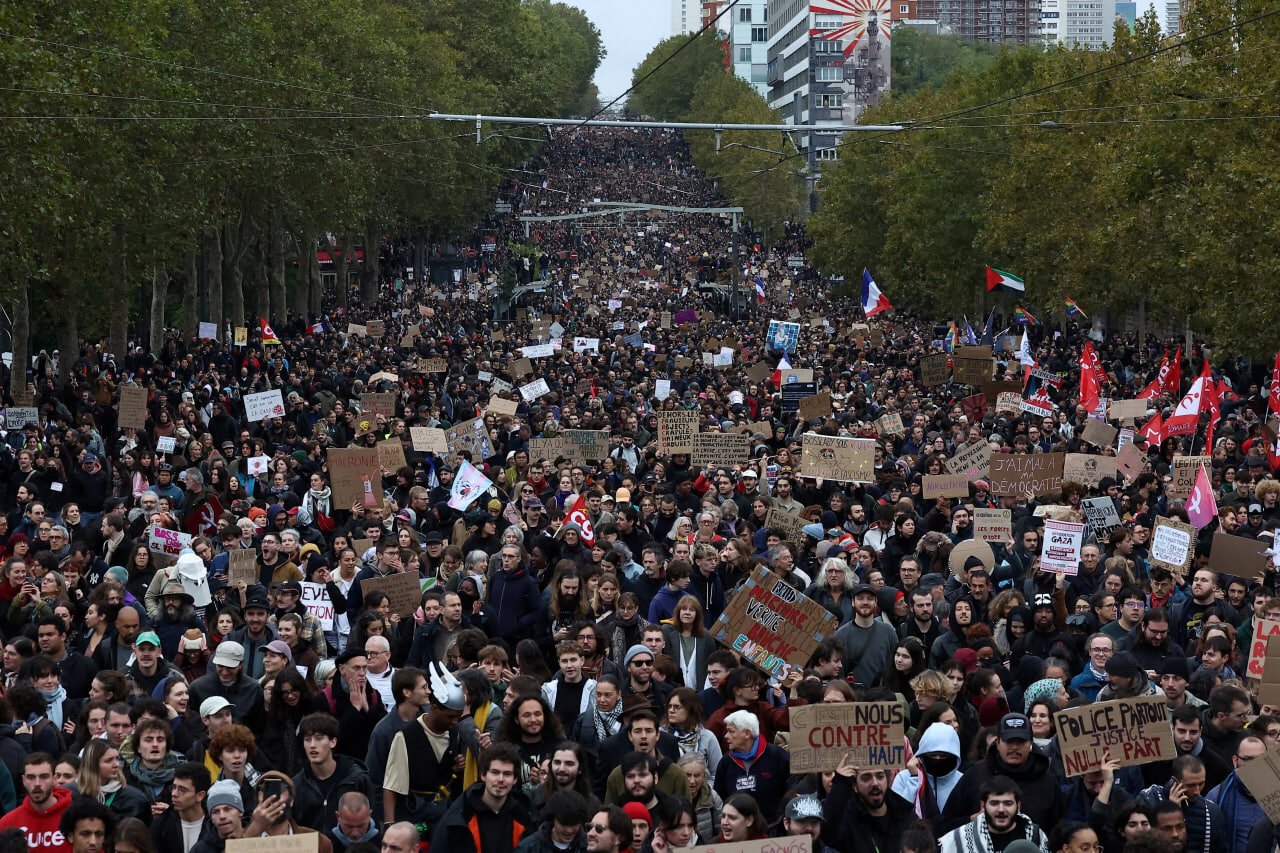
In France on Saturday, the second weekend of mass protests took place. According to available data, police detained 1,314 people, while about 70,000 police officers and gendarmes were deployed to maintain order.
The Interior Ministry initially reported that almost 1,000 people had been detained, after which the figure was raised to 1,314. The ministry also reported 75 fires and 24 looted shops. According to the department, 410,000 people took part in marches across the country, including 110,000 in Paris. Unions and activists say the real turnout was nearly twice that.
According to reports, the number of security officers rose by 20 percent compared with the previous week. The security forces included special units, helicopters, armoured vehicles and water cannon. Shops closed their windows and museums did not operate.
Interior Minister Laurent Nuñez, who defended the security measures, said participants had been able to prevent unauthorised marches and access to city centres.
Earlier, the government banned demonstrations not organised by the unions, which it called "illegal."
Disorder and detentions in other cities
The march in Paris was largely calm overall. Disorder began in the Porte-de-Vincennes area, where the route ended: masked groups threw bottles and stones, police used tear gas, water cannon and stun grenades, and then a wider crowd was attacked with truncheons.
Tear gas was also used in the centres of Lyon, Lille, Montpellier, Nantes and Toulouse. Two people received serious injuries in Clermont-Ferrand and Toulouse; one of the injured reportedly lost a finger. Authorities said investigations were already under way into injuries to children and other protesters, who had been hurt by explosive police devices.
In Nice, prosecutors reported 59 detentions, 11 of whom are suspected of belonging to far-left groups. According to local media, some of those detained were stopped in two cars with masks, gloves, gas canisters and truncheons.
Plan to restrict access to social media
Two days before the march, Prime Minister Sébastien Lecornu wrote to the operators Orange, SFR, Free and Bouygues Telecom, the French publication Blast reported. He asked them to be ready to block TikTok, Instagram, Snapchat and X in the event of "urban violence", and said he wanted the ability to fully suspend access to these services.
The operators replied that they could not do this quickly, and that VPNs allow users to bypass blocking. Earlier, in 2024, France restricted access to TikTok during the New Caledonia unrest and lifted the ban only a few days later.
Political context
The protests began in mid-September: schoolchildren aged 15 to 18 walked out against a shortage of teachers, roof-leak-prone buildings and a lack of classroom chairs. Teachers, parents and unions joined them, and the demands expanded to questions of the cost of living. On 17 October, more than half a million people took part in marches.
According to Ipsos BVA, President Emmanuel Macron's approval rating stands at 15 percent. Jean-Luc Mélenchon, who took part in the march in Paris, warned that protests would be repeated every week if Macron did not give way, and pointed to a possible general strike on 5 November.
Solidarity protests also took place in other European countries: in Madrid, tens of thousands of people went out to defend pensions, while Brussels police used water cannon against students.
Source: tehrantimes.com