

Germany Plans to Double Data Center Capacity Amid AI Concerns
Google, EdgeConnex and Maincubes have reserved sites for data centers in Dietzenbach near Frankfurt am Main. Germany wants to double data center capacity by 2030, but residents are concerned about water and electricity consumption.
 Abdulrahman Sadikhli6 min read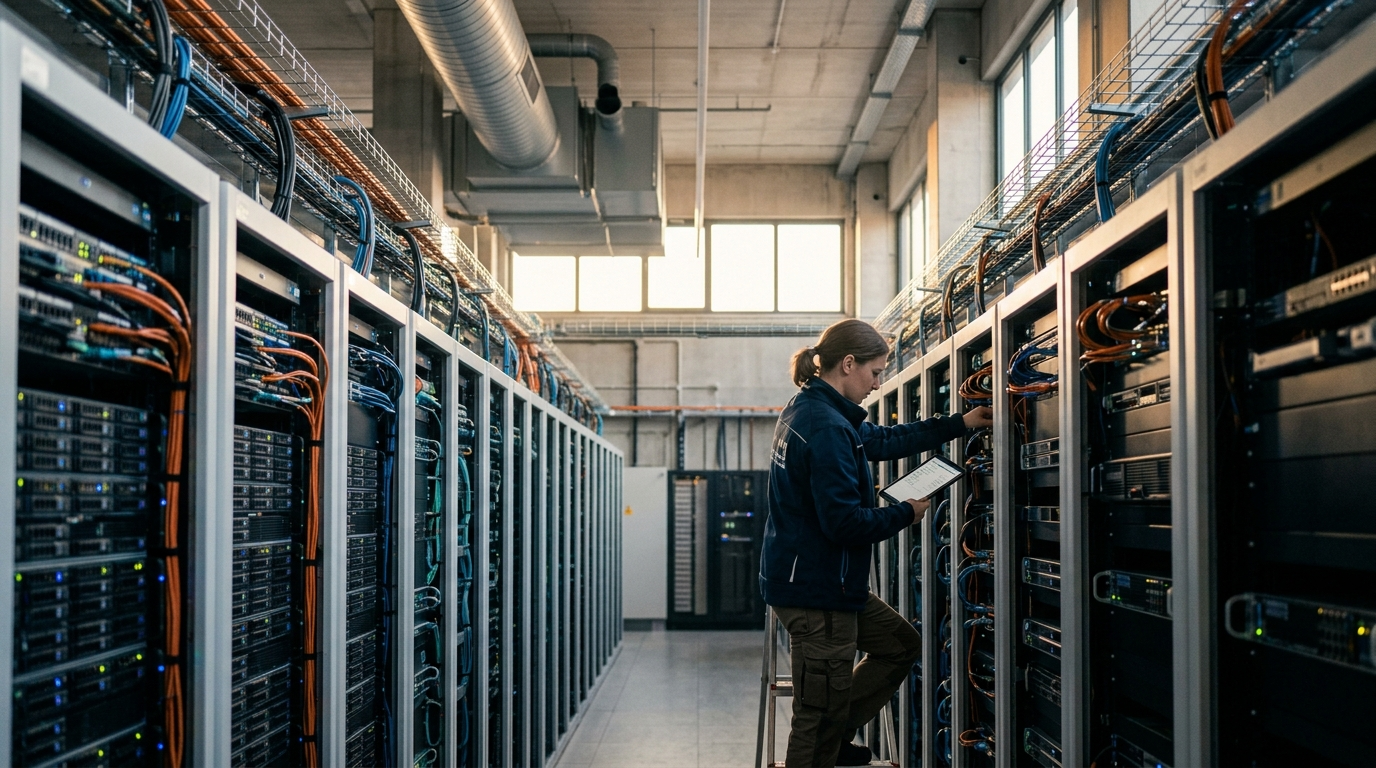
In Dietzenbach, a small town near Frankfurt am Main with a population of 35 thousand, U.S. companies Google and EdgeConnex and German company Maincubes have reserved sites for data centers. One of them — a Google hyperscale center — is being built as part of investments of €5.5 billion ($6.2 billion), which were announced last year.
The Frankfurt region, Germany's financial center, remains one of the world's most attractive locations for cloud service operators, and as demand for computing capacity grows, more centers are planned here. Germany is already Europe's largest data center market both in capacity and number of facilities, while the Frankfurt-Rhine-Main region accounts for more than one-third of the country's total capacity. The region's attractiveness is supported by its proximity to the DE-CIX internet exchange infrastructure in Frankfurt.
Local residents are concerned about water and electricity consumption
Plans for a fourth mega data center have prompted opposition from local residents. Thousands of computers in a data center require large amounts of energy to operate around the clock, generate substantial heat and require cooling, which needs enormous volumes of water. Residents of Dietzenbach who spoke to journalists fear higher water and electricity bills, as well as rising temperatures in the town.
“We want to know two things: what benefit will the local community get here, in Dietzenbach? And what will the impact on the environment be?” said Dietzenbach resident Wilhelm Sauer, pointing to four imposing pipes rising above the EdgeConnex data center.
He and other local activists believe the burden on regional resources may not be offset by the limited number of new jobs announced. Dietzenbach Mayor Dieter Lang of the Social Democratic Party of Germany (SPD) is optimistic: he predicts that the Google data center in his town will create around 100 “highly qualified jobs.”
“We expect a substantial tax contribution,” Lang said.
However, Tara Merck, a researcher of public data centers at the Weizenbaum Institute, is skeptical. In her view, Germany is likely to receive little revenue from data centers operated by U.S. companies “because profits may be taxed elsewhere.”
“Especially when you think of large technology companies — they will not pay taxes in Dietzenbach,” she said.
Information gap
In August 2026, the German government launched a data center register listing energy consumption, water consumption and energy-efficiency measures for facilities already in operation. But the list included only about 300 data centers — far fewer than the estimated 2000 facilities that, according to the government, operate in the country.
“Some companies report their smaller projects, but not their large ones,” said Werner Neumann, a board member of the environmental organization BUND.
There is no official overview of how many data centers are under construction or exactly where they are located. The civic project Heisse Luft (Hot Air) decided to fill this gap and created an online map of planned data centers across Germany, updated daily using crowdsourced data from local communities.
“In theory, we should have access to this information,” said Heisse Luft co-founder Tiziana von Witzleben. “Perhaps the German government does not have the capacity [to collect this information] and share it. But I think this is done deliberately, especially [by] such major players as Google and Amazon. [They] are known for being very secretive about what they do. Because they know: if they tell people, they will get a lot of protests.”
Protests and the goal of doubling capacity by 2030
Unlike in the United States, where the movement mobilized protests across the country, protests against data centers in Germany remain a local phenomenon. In February, the local council of Groß-Gerau in the Frankfurt region voted against a data center costing €2.5 billion ($2.8 billion), proposed by a U.S. operator, partly because of mass protests by residents concerned about waste heat. In Maintal, another EdgeConnex mega data center faced intense protests against plans to build its own gas-fired power plant; the €1 billion project is now seeking alternative energy sources in a region that is already reaching the limits of its power grid.
To achieve the strategic goal of doubling data center capacity by 2030, the federal government — a coalition of the Christian Democratic Union (CDU) and the SPD — has proposed amendments to the Energy Efficiency Act (EnEfG), which regulates energy consumption and climate protection. The Greens question whether the targets are based on real demand. The socialist Left Party, by contrast, is skeptical of expansion in general. Both parties oppose government plans to ease rules to attract more data centers. At the opposite end of the political spectrum, the far-right Alternative for Germany (AfD) supports data center expansion but criticizes a law encouraging the use of renewable energy sources to power them.
The proposed amendment would push back the deadline for operators to meet renewable energy targets and ease requirements for the reuse of waste heat. Despite this, Tara Merck considers the push for energy-efficient data centers in Germany a progressive example in the global context. But she criticizes provisions of the law that would give companies the right to classify data on water and electricity consumption volumes as commercial secrets.
“This proposed amendment significantly shifts the regulatory environment in favor of operators,” she said. “Having good data is necessary for regulation, intervention and building trust and acceptance in local communities.”
“I think [the lack of transparency] will ultimately contribute to growing antagonism between data centers and local communities, making it harder for operators to expand or even maintain existing sites in their current form,” Merck warned.
AI watchdog Algorithm Watch said in a public statement that the legal changes proposed by the government are aimed not at reducing bureaucracy, but rather at appeasing U.S. technology giants Microsoft, Google and Vantage.
“German and European operators generally have no problems with the current rules,” the Algorithm Watch statement said. “The amendments run counter to the government's own goal of strengthening German/European companies.”
In the summer, the organization launched a campaign and collected 150 thousand signatures against amendments to the law, calling for data centers' public reporting obligations to be maintained. The amendments were presented to the Bundestag in September. If the new law is adopted, the government hopes it will enter into force in January.
Source: dw.com