

Building collapse in Istanbul’s Maltepe: CNN TÜRK expert assesses the causes
The lower two floors of a seven-storey building collapsed in Istanbul's Maltepe district. Two people died and three more remain trapped under the rubble, and an expert assessed the possible causes.
 Yulduz Salimov3 min read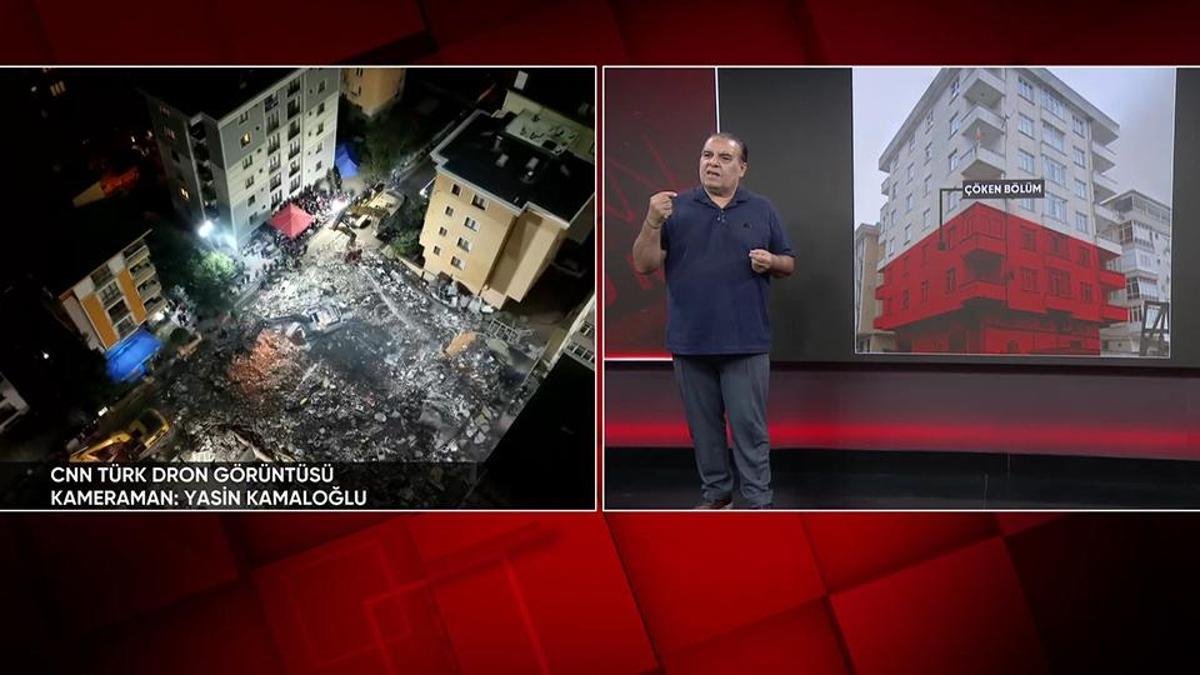
In Istanbul's Maltepe district, the lower two floors of a seven-storey building collapsed. According to data as of 8 October 2026, two people died and three more remain trapped under the rubble, with search-and-rescue operations continuing. Authorities are investigating whether negligence played a role.
The causes of the collapse were assessed on CNN TÜRK by Professor Hasan Yıldırım, a faculty member in the Department of Construction Engineering at Istanbul Technical University (İTÜ).
"A building does not collapse all at once while staying in place. Note that the upper part does not fly apart, while the lower part gives way. The collapse happens in such a way that the lower part is crushed and the upper part settles onto it. Why does this happen? The concrete in the lower floors may be of poor quality, it may have deteriorated over time, and the reinforced-concrete elements may have weakened because of how they were used," Yıldırım said.
According to him, if the damage had affected the side columns, the building would have tilted and fallen to one side. In that case, the expert noted, the damage is concentrated in the middle section of the structure.
Yıldırım dwelt separately on the quality of the concrete. He recalled that sea sand is used around the world, but the problem lies in how it was used in those years.
"Sea sand is used around the world. The problem is that back then it was taken straight from the sea — without washing out the salt, without sieving and processing. In concrete it compacts poorly, forming a void structure similar to a briquette. During corrosion, blistering appears in the concrete," he explained.
The expert added that his CNN TÜRK colleagues brought concrete samples, and they do not look of very good quality. According to him, the concrete may have been poor, but the earthquake of magnitude 6.2 also played its role.
What the cracks indicate
Yıldırım stressed that with poor concrete, even minor damage makes itself known through cracks, but non-specialists often do not attach importance to them.
"When cracks appear in buildings, plaster peels off, reinforcement in the columns bends outward, corrosion occurs — that means there is a problem. Engineers need to be invited and a survey carried out. We talk about this all the time, but it is not done," the expert stressed.
He noted that large cracks spreading from corners and windows are a sign of building movement, and urged citizens to turn to engineers and specialists when they appear.
Source: cnnturk.com