
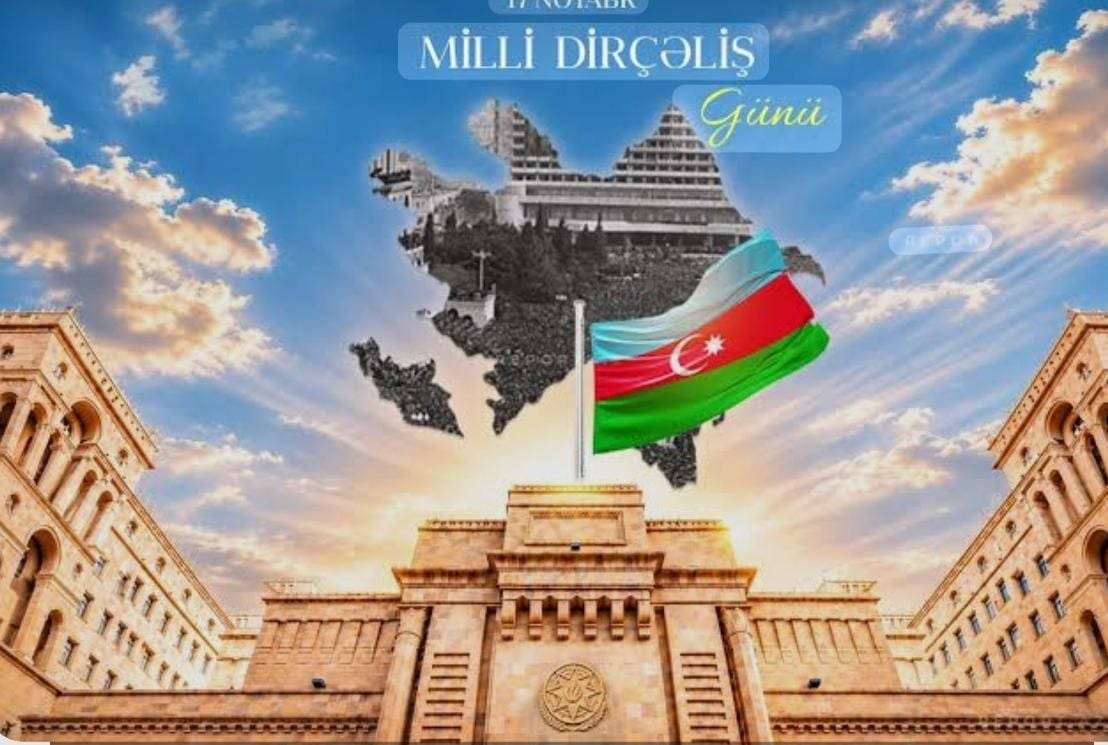
November 17 – National Salvation Day: The Road from Azadlig Square to Independence
November 17 is marked as National Salvation Day in Azerbaijan. The article traces the 1988 rally in Baku's central square, its political development, and the path to the restoration of independence in 1991.
 Tunzale Melikova9 min read
Updated: November 17, 2026 1:10 pm
November 17 is not an ordinary date in Azerbaijan's history. It is the day when the national will of the people was clearly expressed, when different social groups gathered in one square, and when a turning point was created on the road to Azerbaijan's independence.
On November 17, 1988, in the centre of Baku, a rally that began in the area then called Lenin Square and now known as Azadlig Square created a significant political and social impulse for the processes that followed. The protest of the Azerbaijani people was initially formulated around the Karabakh issue and Armenia's territorial claims against Azerbaijan, but within a short period it grew into a broader idea of national liberation and independence.
The Beginning of National Awakening
1988 began for Azerbaijan with serious political events. The mass expulsion of Azerbaijanis living in Armenia from their native lands, the strengthening of separatist tendencies in Nagorno-Karabakh, and Moscow's response to these events caused serious discontent in Azerbaijan.
In November of that year, the killing of people in Shusha's Topxana forest and the spread of news related to it further increased tensions in a society that was already strained. According to the National Azerbaijan History Museum, the Topxana incident was one of the main factors that influenced the beginning of mass protests in Baku.
People from different social groups began to gather in the central square of Baku. The main target of the protests was not only Armenia's policy towards Azerbaijan. People also objected to the Kremlin's attitude to the issue and to the fact that Azerbaijan's national interests were not being defended.
Subsequently, the rally that began on November 17, 1988, gradually turned into a broad popular movement.
Official Azerbaijani sources assess these events as an important stage of the national awakening and national liberation movement. The official website of the President notes that the protest campaign, which began on November 17 and lasted for a long time, carried significant importance on Azerbaijan's path to independence.
Azadlig Square – A Tribune of the People
In November 1988, the square in Baku was no longer just a rally venue. It had become the main political centre where Azerbaijan's national will was expressed.
From the square's tribunes, people from different social groups spoke, stating that Karabakh is an inseparable part of Azerbaijan, demanding an end to Armenia's policy towards Azerbaijan, and calling on Moscow to show an objective attitude to the issue.
As time passed, the demands became increasingly political. The ideas of national freedom, national rights, and Azerbaijan's right to self-determination occupied an increasingly large place in society's agenda.
From this perspective, it is not sufficient to assess the events of November 17 only as a protest against the Karabakh issue. These events marked the beginning of a new stage in the formation of national identity in Azerbaijani society.
Official Azerbaijani sources also present the events of that period as one of the main stages on the road to independence.
The Square Could Be Dispersed, but Not the National Will
The Soviet authorities attempted to keep under control the popular movement that had emerged in Azerbaijan.
On November 22, a large contingent of Soviet troops was brought into Baku and a curfew was declared. However, despite all this, the protests in the square did not stop.
According to official information, the mass rally was dispersed only during the night of December 4 to 5 through the use of Soviet troops and armoured vehicles.
However, although the rally in the square was physically suppressed, it was not possible to stop the political and spiritual process it had created.
This was one of the most important outcomes of the events.
Because the demands voiced in the square in November 1988 were no longer limited only to protest against a specific event. Ideas of national statehood, sovereignty, and independence were increasingly strengthened in Azerbaijani society.
The Visibility of the Tricolour in the Square
One of the moments of special symbolic importance in the history of National Salvation Day was the raising of the tricolour flag of the Azerbaijan Democratic Republic in the square.
The National Azerbaijan History Museum reports that during the 1988 square movement, the tricolour flag of the Republic of Azerbaijan was raised for the first time.
This fact was particularly significant. At that time Azerbaijan was part of the Azerbaijan SSR, and the reappearance in public space of the state symbols of the Azerbaijan Democratic Republic, which existed in 1918–1920, became one of the important indicators of the revival of national memory.
In the following years, the tricolour flag would become one of the most important symbols of Azerbaijan's idea of independence.
The Role of November 17 on the Road to Independence
The main historical significance of National Salvation Day emerges precisely here.
In October 1991, Azerbaijan restored its state independence. However, before the independence was proclaimed by legal acts, it was necessary for the idea of national statehood to take shape in society, for the idea of freedom to strengthen, and for the national will to turn into a political process.
The 1988 square movement played an important role from this perspective.
November 17 is regarded as one of the starting points of this process. The idea of independence among the Azerbaijani people then began to move beyond the ideas of separate intellectuals and political activists and turned into a broad public idea.
Subsequent events in Azerbaijan's state history continued this line.
On October 18, 1991, the Constitutional Act on the restoration of Azerbaijan's state independence was adopted. From 1992, November 17 began to be officially observed as National Salvation Day.
What Does National Salvation Mean?
The word "salvation" itself carries a special meaning on this day.
National salvation does not simply mean going out to squares and protesting. This concept expresses the revival of national memory, the strengthening of national identity, the formation of the idea of statehood, and the emergence of the will to decide the future of the people.
In Azerbaijan in 1988, various elements of this process emerged at the same time.
On the one hand, national solidarity arose around the Karabakh issue. On the other hand, opposition to the Soviet system's attitude towards Azerbaijan intensified. At the same time, the state heritage of the Azerbaijan Democratic Republic returned to the agenda, and national symbols began to return to public life.
All of this brought about a serious change in the political atmosphere of society.
From November 17 to 1991
Looking back at history, it is possible to see that the events of November 1988 were only one part of the road to the restoration of Azerbaijan's independence.
After the square movement, the national liberation movement spread across the country. In late 1989 and early 1990, the process grew more intense. The events of January 20 became one of the bloodiest pages in the confrontation of the Azerbaijani people with the Soviet authorities.
However, January 20 did not stop the national will.
In November 1990, at a session of the Supreme Assembly of the Nakhchivan Autonomous Republic, the tricolour flag of the Azerbaijan Democratic Republic was adopted as the state flag of Nakhchivan. This decision was also an important stage in terms of restoring national state traditions.
In 1991, Azerbaijan restored its state independence.
Thus, the national awakening that began at the 1988 square rally became, several years later, an important part of the historical process that resulted in the creation of an independent state.
A Further Stage in History – 2020
The meaning of National Salvation Day for modern Azerbaijan is not limited only to the events of 1988.
In the later history of Azerbaijan, issues of national statehood and territorial integrity remained on the country's main political agenda for many years.
The Second Karabakh War in 2020 and the restoration of a large part of Azerbaijan's territorial integrity created a new stage in the history of statehood.
From this perspective, it is possible to see a historical link between the national will expressed in the 1988 square and the goals facing the state in the following decades.
The essence of National Salvation Day is to preserve the memory of this long road: from national unity to political will, and from political will to an independent state, and up to ensuring its sovereignty and territorial integrity.
What Does National Salvation Day Mean Today?
Today Azerbaijan is no longer the Azerbaijan of 1988.
At that time, the people sought to express their rights and national will within the Soviet system. Today Azerbaijan makes its own political and economic decisions as an independent, sovereign state.
However, although history changes, the message of November 17 does not: statehood is sustained not only by political institutions but also by national memory, unity, and the will to take responsibility for society's future.
In November 1988, in front of the people who gathered in Baku's square, today's Azerbaijan did not exist. Before them there was not yet an independent state, a tricolour flag, a national army, or a sovereign political system.
But there was one thing: will. It was this will that became one of the factors that changed the direction of Azerbaijan's subsequent history.
Marking November 17 today is, in fact, not only a matter of recalling the past. This date also reminds us on what political and social memory the independence was built.
November 17 – National Salvation Day is the day when the desire for freedom, national solidarity, and the statehood will of the people of Azerbaijan became history.
And the history that began in the square in November 1988 is today an inseparable part of the national memory of independent Azerbaijan.