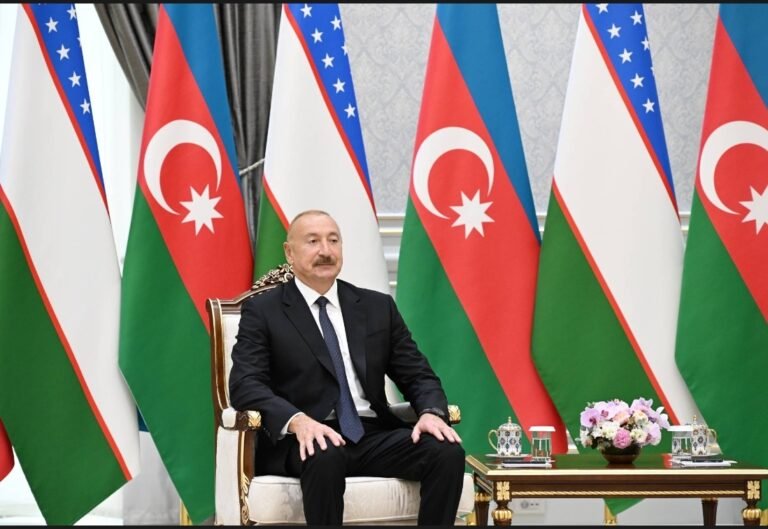

Not Just Two Countries, but a Geo-Economic Line
A new stage in Azerbaijan–Uzbekistan relations: Where is the Baku–Tashkent line heading?
 Tunzale Melikova6 min read
A new stage in Azerbaijan–Uzbekistan relations: Where is the Baku–Tashkent line heading?
Analytical perspective
Journalist Fira Jalilova
When speaking about Azerbaijan and Uzbekistan, the first words that usually come to mind are "brotherhood," "shared history," and "Turkic world." However, recent realities show that explaining these relations solely through these concepts is no longer sufficient. A new line is taking shape between Baku and Tashkent—one built not only on diplomacy, but also on trade, investment, logistics, energy, technology, and regional connectivity.
For me, the most compelling aspect of Azerbaijan–Uzbekistan relations is precisely this: history has united us, but economic interests are propelling us into the future.
Two countries, one large market
The combined population of Azerbaijan and Uzbekistan is approaching nearly 50 million. However, it would be wrong to view this figure merely as the domestic market of two individual nations.
Azerbaijan serves as a crucial bridge between Europe and Central Asia, while Uzbekistan stands as one of Central Asia's largest demographic and manufacturing hubs. When these two potentials merge, a much broader economic geography emerges.
In other words, this is not just about Baku and Tashkent. It is about a new economic corridor connecting Central Asia across the Caspian Sea to the Caucasus and Europe.
The main issue is not just trade, but the route itself. Increasing trade turnover between the two countries is vital, but even more important is the network of routes through which this trade will flow.
The growing strategic importance of the Middle Corridor in recent years has given new substance to Azerbaijan–Uzbekistan relations.
Delivering goods from Uzbekistan to Europe via Azerbaijan, while expanding Azerbaijan's access to Central Asian markets, opens up new economic opportunities for both sides.
In 2025, transit cargo volume between Azerbaijan and Uzbekistan reaching 1.4 million tons demonstrates real dynamic progress in this direction. To me, this figure is not merely a statistic; it is an indicator of a new economic map.
Tashkent is changing. The internal economic transformations underway in Uzbekistan also create compelling opportunities for Azerbaijan. In recent years, the country has taken significant steps toward attracting foreign investment, industrialization, digitalization, and establishing modern financial mechanisms.
Tashkent's moves toward becoming an international financial center are part of this strategic vision. This process is equally important for Azerbaijani companies, because Uzbekistan is no longer just a market for selling goods; it is striving to become a regional platform for accessing broader Central Asia.
Azerbaijan's advantage is no longer limited to energy. A major shift is taking place in our country's regional role. For many years, Azerbaijan was primarily recognized for its energy resources.
Today, however, another decisive factor enhances Azerbaijan's position: geographic connectivity.
The Baku International Sea Trade Port, railway infrastructure, Caspian maritime shipments, and the Middle Corridor significantly boost Azerbaijan's transit capabilities. From this perspective, Azerbaijan is no longer just an energy exporter.
Azerbaijan is increasingly becoming a core pillar of logistics and trade connectivity between East and West. Cooperation with Uzbekistan forms a key Central Asian component of this overarching strategy.
An interesting point: relations are now clearly visible in tangible joint projects.
The true strength of Azerbaijan–Uzbekistan relations is often displayed far more in actual projects than in official meetings. Projects involving Azerbaijani companies are being implemented in Uzbekistan across banking, education, energy, construction, tourism, and agriculture. Simultaneously, Uzbek companies are expanding their footprint in the Azerbaijani market. This proves that ties are no longer restricted to one country simply investing in the other.
A framework of mutual economic interest has already solidified, and for a long-term partnership, no factor is more crucial. The energy map is changing as well.
Energy cooperation between Azerbaijan and Uzbekistan carries distinct importance. Alongside traditional energy sectors, green energy initiatives could become a major focal point in the coming years. Connecting the Caspian region's renewable energy capacity with Central Asia could foster the creation of a broader regional energy network.
In this regard, Baku–Tashkent cooperation is designed not just for today's economic environment, but for the economy of the future.
The greatest capital is trust.
Underpinning all of these developments is one fundamental element: mutual political trust. Investors do not commit long-term capital where they perceive political risk. Logistics firms do not rely on unstable transit routes. Major energy ventures cannot materialize without steadfast political will.
The key advantage for Azerbaijan and Uzbekistan is the high level of political trust between their leadership, which effectively translates into concrete economic projects.
The Treaty on Eternal Friendship signed in Tashkent on August 23 plays a vital role in further solidifying the political and legal foundations of these relations.
So what comes next?
In my view, in the coming years, the main competition in Azerbaijan–Uzbekistan relations will not center on who sells more products.
The central question will be: who can integrate more deeply into the broader regional supply chain?
Here, Azerbaijan's strength lies in the Caspian Sea, logistics infrastructure, and connections to Europe.
Uzbekistan's advantage lies in its sizable population, manufacturing output, and strategic location in the heart of Central Asia. These advantages naturally complement each other. That is why I would not view Azerbaijan–Uzbekistan relations merely through the lens of ties between two brotherly nations.
These relations are entering a phase where two economies complete one another and bridge two regions. History brought us together, politics brought us closer, and economics is solidifying that bond. Looking at the map today, you do not see just a line between Baku and Tashkent; a new geo-economic vector is emerging. Exactly how far this line will extend will become clear in the coming years.
Yet one thing is already evident: the most compelling chapter of Azerbaijan–Uzbekistan relations is still ahead.