
Lithuania Mobilizes 100,000 People Over Threat of Attack from Belarus
Lithuania plans to form a civilian reserve of about 100,000 people. The announcement was made by National Crisis Management Center head Vilmantas Vitkauskas.
 Abdulrahman Sadikhli3 min read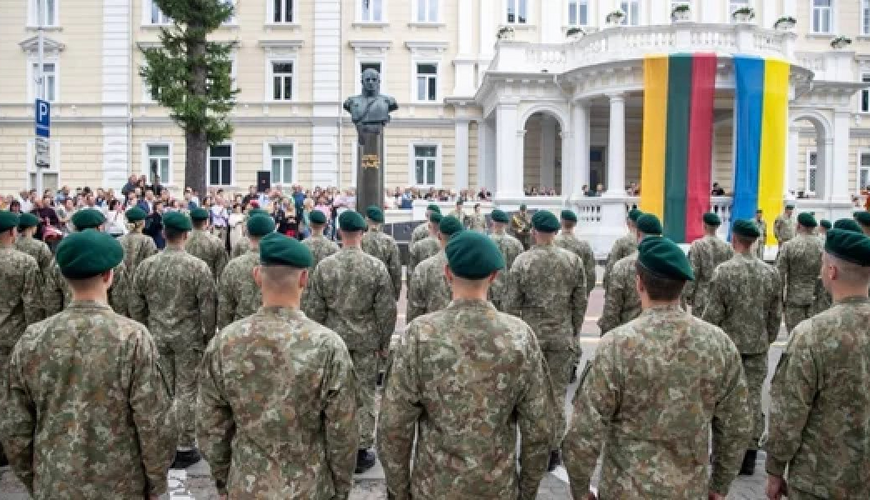
Lithuania plans to bring about 100,000 people into the civilian reserve. National Crisis Management Center (MBĮM) head Vilmantas Vitkauskas said this at a government press conference.
According to him, the reserve already includes Lithuanian citizens whose professional knowledge and official duties are considered important for carrying out mobilization plans. The list includes state and municipal employees, doctors, engineers, IT specialists, energy workers, logistics specialists and police officers. Some of them have already been entered into the relevant lists.
“The main goal is to form a unit of about 100,000 people in the reserve,” Vitkauskas said.
During mobilization, these specialists are to remain at their workplaces and ensure the uninterrupted operation of healthcare, energy, communications, public administration and other vital systems. They are not planned to be assigned to other mandatory duties.
Vitkauskas also said Lithuania and Poland are preparing an international evacuation plan. It provides for the evacuation of part of the populations of Lithuania, Latvia and Estonia through the Polish border if necessary. Lithuania’s internal national plan is already ready, while work on the cross-border document is continuing.
In the event of a military threat at the border, border controls may be restored to ensure mobilization and prevent specialists in critically important positions from leaving the country. At the same time, Lithuania and Poland plan to agree in advance on entry rules to avoid large crowds at the border.
“Vitis Birliyi 2026” Exercises
The prepared plans will be tested as part of Lithuania’s largest annual mobilization exercises, “Vitis Birliyi 2026”, which are taking place from September 25 to October 3. About 3,000 state employees, municipal workers, representatives of agencies and companies, as well as around 1,000 volunteers, are taking part in the exercises.
Under the exercise scenario, agencies will practice a sharp deterioration in the military-political situation, disruptions to energy and communications, the reception of allied forces and the introduction of a mobilization regime in the country. The evacuation of residents of Vilnius and border areas is also envisaged in the event of a possible threat of military intervention from Belarus.
In July, Lithuania’s Ministry of the Interior approved the state evacuation plan. According to calculations, in the event of a threat, 75% of the population will be able to leave the territory independently. Local authorities will be responsible for evacuating the remaining residents — primarily families with children, elderly people and people with disabilities.
Increase in Military Spending
Lithuania is also expanding its military force and defense budget. Under amendments approved by the Seimas, the maximum number of military personnel will increase from 20.8 thousand to 29.4 thousand people, while annual conscription will rise from 4.2–7 thousand people.
Presidential adviser Marius Česnulevičius said the National Council for Universal Defense Coordination would propose introducing universal military conscription by 2030 instead of 2035. Lithuania abolished compulsory military service in 2008 and restored it in 2015.
The 2026 defense budget allocates 4.8 billion euros, equivalent to 5.38% of GDP. Prime Minister Mindaugas Sinkevičius said spending would continue to be maintained at no less than 5% of GDP. The funds will be used to form a national division of 20,000 people, strengthen air defense systems and receive a German military brigade.
Source: musavat.com